

Universiti Malaysia Sabah (UMS) and the Royal Institution of Surveyors Malaysia (RISM) have formalised a Letter of Intent (LoI) recently to strengthen collaboration in academic development, professional training and research in surveying, engineering and the built environment.

The LoI was jointly signed by UMS Vice-Chancellor, Prof. Datuk Dr. Kasim Haji Mansor and RISM President, Sr Wan Ainon Zuraiha Wan Abd Khalid, marking a significant step forward in institutional partnership.

The signing ceremony was held during the 9th Sabah International Surveyors Congress (9SISC) organised by RISM Sabah Branch at the Sabah International Convention Centre (SICC).

Also present were member of the UMS Board of Directors, Datuk Aliasgar Basri, Director General of Dewan Bandaraya Kota Kinabalu (DBKK) Datuk Sr Lifred Wong, RISM Sabah Branch Chairman Ts Sr Allen Leslie Chin, Deputy Chairlady of RISM Sabah Branch and Organising Chairlady of the 9SISC Sr Melissa Felix Lee, Immediate Past Chairman of RISM Sabah Branch Sr Robert Tseu, UMS Faculty of Engineering Dean Associate Prof. Ir. Dr. Abu Zahrim Yaser, and coordinator of the Built Environment Programme Prof. Ar. Nurakmal Goh.

In their addresses, Kasim and Allen expressed sincere appreciation for the initiation of this significant milestone between UMS and RISM. They stated that this collaboration will strengthen the relationship between academia and the professional sector in line with the shared vision of producing UMS graduates who are professional, competent and ready to meet emerging industry needs.

“This collaboration represents our collective aspiration to support the growth of Sabah and the nation through education, innovation and industry engagement,” Kasim said.

He said the future collaboration covers joint seminars, workshops, guest lectures, curriculum with industry relevance, industrial training, staff and student attachments and technical visits to RISM members’ companies, which would provide UMS students with real exposure to professional practice.

According to him, the LoI further promotes joint research and publication in areas such as construction management, sustainable design and Building Information Modelling (BIM), which includes capacity-building programmes, community outreach initiatives and sustainability-driven activities, reflecting the shared responsibility to contribute positively to society and the environment.

Kasim highlighted that the partnership includes planning of Continuing Professional Development (CPD) activities for RISM members and UMS academicians, as well as micro-credential programmes that aim to strengthen the lifelong learning and enhancing graduate employability.

He announced that UMS would introduce two new degree programmes under the Built Environment cluster, the Bachelor of Architecture in March 2026 and the Bachelor of Quantity Surveying in September 2026.

Kasim said the signing represented trust, collaboration and shared purpose, adding that UMS and RISM were committed to nurturing the next generation of professionals who would drive Sabah’sprogress.

“With RISM’s professional expertise and UMS’s academic strength, I am confident that Sabah can position itself as a hub of professional excellence and sustainable development, the true Brain of Borneo,” he said.

Allen highlighted that RISM will provide a strong commitment to UMS for improving the students’ skills, knowledge and quality in professional development, and hope that the collaboration will continue for many years to come and continue to benefit the next generation of students.

“It is a wonderful beginning to have UMS lecturers joining in this year’s congress as organising committee members,” Allen said.

As concluding remarks, Kasim and Allen expressed appreciation to all contributors involved in the congress and looking forward to the success of future collaborations between the academics and industry.


Universiti Malaysia Sabah (UMS) continues to strengthen its national standing as its student-led innovation project, ReIPvolution, garners an outstanding series of recognitions through the rural education initiative SULAM ReIP.
According to a statement by Centre for Academic Excellence and Development (CAED), this achievement not only elevates UMS’s reputation as an institution committed to community development but also highlights the ability of its students to produce creative, high-impact solutions in addressing educational disparities in rural areas.

“Originally introduced as Reading in Paradise (ReIP), a modest effort to restore reading access in a rural primary school, the project has since evolved into EduTaman Inspirasi, a creative outdoor learning space that integrates literacy, arts, emotional well-being, and experiential education.

“Implemented under Service-Learning Malaysia–University for Society (SULAM) through the Social Inequality course at the Faculty of Social Sciences and Humanities (FSSK), this initiative provides students with a meaningful platform to translate academic theories into real, impactful community engagement.

“Beyond applying classroom knowledge, students also cultivate essential values such as leadership, empathy, and teamwork, while gaining firsthand exposure to the challenges faced by underserved communities,” according to the statement.

CAED also emphasized that the experience not only enriches their academic journey but also shapes them into socially responsible individuals equipped to contribute to long-term societal development.

“The year 2025 marked a breakthrough for ReIPvolution, which secured a remarkable series of achievements: Gold and Best Presenter at SUISS, Gold at IPICTL × SULAM@UPM, Gold at SULAM UMS, Gold and Second Best Project at SULAM@UPSI, and Gold at the SPSSK 2025 Research Poster Competition.


“The project was also selected as a national finalist for SULAM Innovate, scheduled for November under the Ministry of Higher Education (KPT).

“In recognition of its substantial impact on rural communities, the team was further honoured with the Sabah Academic Excellence Award (AKSA), carrying a cash prize of RM8,000.

Meanwhile, course coordinator Ramlah Daud said the series of achievements reflects UMS’s strong commitment to community empowerment through SULAM while shaping high-impact student leaders.


“SULAM does not only open doors for students to contribute to society; it shapes the character, leadership, and empathy needed in the real world,” she said.

Project leader Muhamad Khalif Fiqri bin Mohd Rusdy@Suis, a final-year student from the Sociology and Anthropology Programme, represented UMS in several national showcases.

His involvement highlighted the university’s commitment to empowering students through impactful community-based initiatives.

At IPICTL × SULAM@UPM, Muhamad Khalif delivered a compelling presentation of the SULAM–ReIPvolution project to academic assessors.


His strong presentation skills and leadership contributed significantly to the team’s success in securing a Gold award at the event.


A total of 658 participants and 20 presenters from 17 countries attended the Global Virtual Conference on Digital Transformation in Higher Education (DX25), organised by Universiti Malaysia Sabah (UMS) at the Sabah International Convention Centre (SICC) recently.
In a statement today, UMS said the event was coordinated by its Centre for Internationalisation and Global Engagement (PPPG), with support from the Faculty of Education and Sports Studies (FPPS) and the DX.SEA UMS Project Committee.

Held under the theme “Redefining Possibilities in Digital Transformation”, the conference also marked the conclusion of the Erasmus DX.SEA Project involving 11 universities from Europe and Southeast Asia to strengthen digital transformation initiatives in higher education institutions in Lao PDR, Cambodia and Malaysia.

UMS said six keynote speakers delivered presentations at the event, representing the Commonwealth of Learning (Canada), Tallinn University of Technology (Estonia), Universiti Teknologi Malaysia, Universiti Sultan Zainal Abidin, Riga Technical University (Latvia) and Universiti Teknologi Malaysia.

Conference Chair and PPPG Director Assoc Prof Dr Wardatul Akmam Din said the programme enabled experts to outline current developments and share institutional practices in digital learning.

“The conference served as a platform for discussing approaches to advancing digital transformation in higher education,” she said.

UMS added that a networking session with the EUROASIA Digital Learning Network (EDLAN) was held to explore future cooperation among partner institutions.

A three-day DX.SEA Project Workshop was also conducted to review project outcomes, including module development, training activities, quality assurance and sustainability planning. Project details are available at https://dxsea.co.

The conference was supported by the Malaysian e-Learning Council for Public Universities (MEIPTA).


The visit of the delegation from the Faculty of Food Science and Nutrition (FSMP), Universiti Malaysia Sabah (UMS) to Universitas Brawijaya (UB) and Universitas Islam Malang (UNISMA) recently marked a new chapter in strengthening research and academic collaboration networks between Malaysia and Indonesia.
The UMS delegation consisted of Dean of FSMP, Professor Ts. Dr. Hasmadi Mamat, Director of the Halal Services and Research Centre, Dr. Mohd Hazim Mohd Yusop, and FSMP Mobility Coordinator, Ts. Dr. Ahmad Hazim Abdul Aziz.

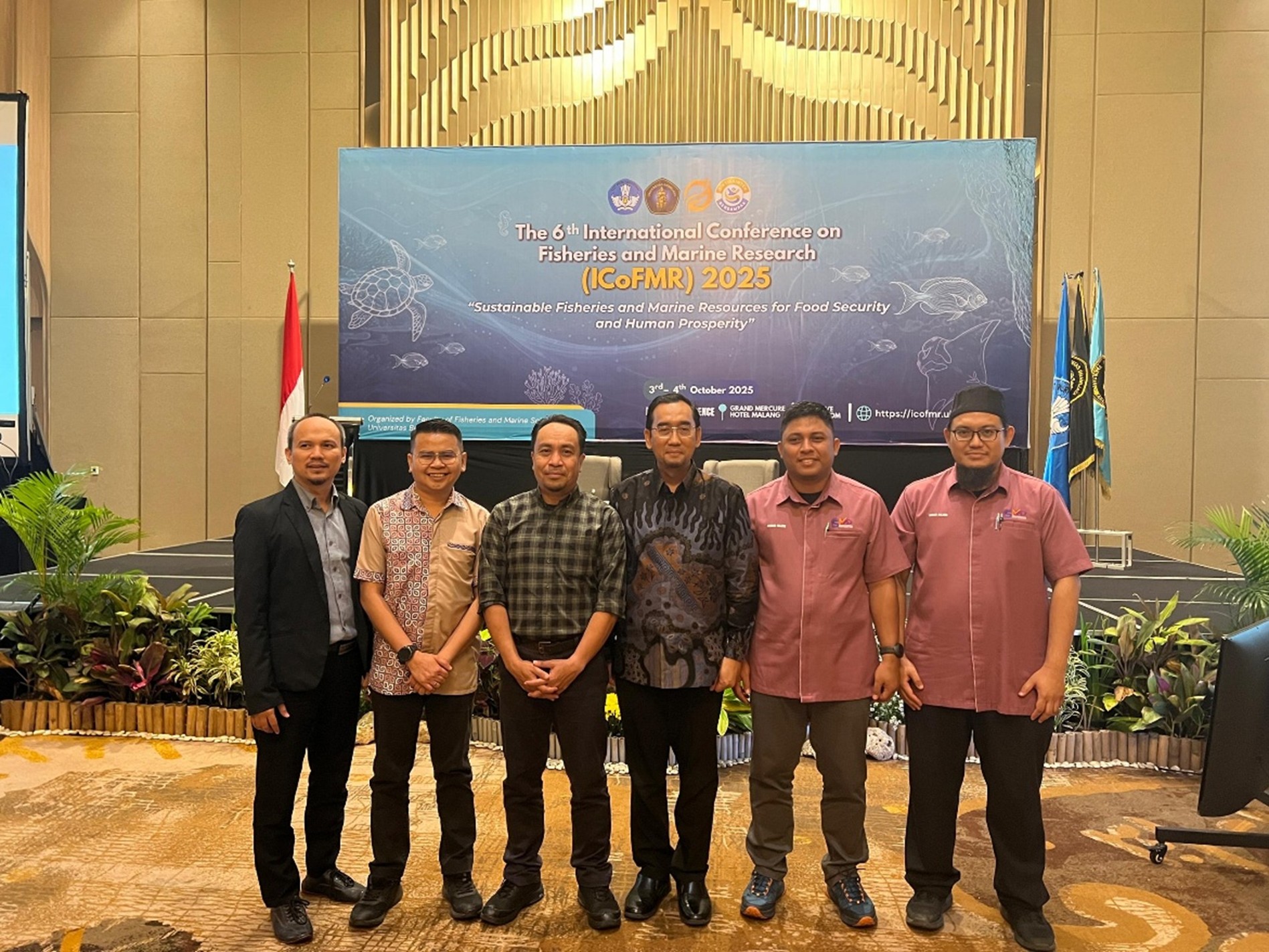
According to the statement by FSMP, , the FSMP delegation also attended the 6th International Conference on Fisheries and Marine Research (ICoFMR 2025) organized by Universitas Brawijaya during their stay in Malang, Indonesia.

In the session, a bilateral discussion was held to explore the potential for joint research, co-publications, and the implementation of staff and student mobility programmes between UMS and UB.

The arrival of the UMS delegation at Universitas Brawijaya was welcomed by Rector of UB, Profesor Dr. Widodo, and Dean of the Faculty of Fisheries and Marine Science, Profesor Dr. Ir. Asep Awaludin Prihanto.

Both parties expressed their commitment to strengthening research and academic relations in the fields of food science, halal studies, fisheries, and marine resource innovation.

Meanwhile, UMS’s visit to UNISMA focused on the development and innovation of honey-based products, including potential collaborations in research and the development of functional food products.

This official visit serves as a starting point for a long-term strategic relationship between UMS, UB, and UNISMA, towards regional sustainable development through the enhancement of food science, halal studies, fisheries, and marine resource fields.


Political campaigners in the upcoming Sabah State election must adopt authentic, youth-centric strategies on social media to effectively engage young voters.


Despite being prolific users of platforms like TikTok and Instagram, their participation is largely passive, more about consuming content than contributing to political discourse, new research by Dr. Latif Lai of the Faculty of Social Sciences and Humanities, Universiti Malaysia Sabah, has found.

Titled “Beyond the Ballot: Measuring Political Literacy in the Age of Social Media,” the study reveals a critical gap between Gen Z’s high social media usage and their low levels of political literacy and engagement.

Presenting his findings at the 3rd Regional Symposium on Social Sciences and Humanities Issues held today, Dr. Lai highlighted a disconnect between the perceived political agency of young voters and their actual knowledge. “While Gen Z shows moderate levels of political efficacy, the mismatch with their factual understanding puts them at risk of misinformation,” he explained.

Based on a survey of 344 undergraduates in Sabah, the study concludes that traditional, top-down campaign methods are no longer effective.

To win over this generation, political parties must embrace interactive, visually engaging approaches that resonate with youth concerns, such as the cost of living, employment, and mental health, on platforms they already frequent.

Page 1 of 379