


VISION, MISSION, OBJECTIVES, LOGO & COKMAR

To become an innovative university of international standing.

To achieve academic excellence across diverse fields of knowledge, gaining international recognition through teaching, learning, research, publication, and community service—while fostering a balanced integration of intellectual specialization and student character development to produce high productivity and quality within the context of societal aspirations and national development.
To achieve internationally recognized academic excellence across multidisciplinary programs, including science, technology, engineering, business, economics, politics, and social sciences.
To explore, preserve, and effectively utilize knowledge for the development of society and the nation, in alignment with the ethos of the university and the country.
To uphold academic freedom and maintain intellectual rigor within the university community.
To produce graduates who are specialized yet well-balanced, competent, pious, and patriotic.
To offer high-quality and socially relevant academic and research programs, while developing intellectual property and innovation.
To develop viable commercial university projects that generate sustainable financial returns.
To foster close and meaningful collaborations between the university and industry, government, professional bodies, and society.
To cultivate and instill universal human values and open-mindedness with a strong sense of responsibility among scholars, staff, and support personnel—while achieving optimal and high-quality outcomes.
To contribute to robust economic growth and social justice through research, publication, consultancy, technological advancement, and community service within an environment of learning, knowledge pursuit, and efficient governance.
To elevate the stature and prestige of the university as a distinguished, progressive, and leading societal institution that consistently leverages its scholarly achievements.
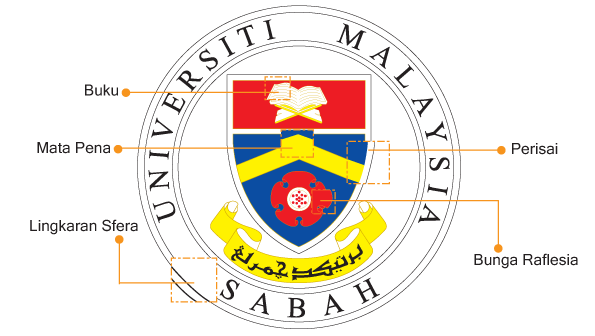
The "Perisai" symbolizes the strength of the university as a unified force of energy working together to uphold its vision.
An open book placed upon a rehal symbolizes the divine gift of knowledge bestowed upon humanity. It serves as a source of intellectualism, faith, and wisdom. The book also represents the spirit of exploration—driven by the senses and a mind that is ever curious and analytical.
The "mata pena" represents precision and depth in the appreciation of knowledge. The "pena" itself is a manifestation of intellect—originating in the mind and expressed through written language. A "mata pena" pointed upward signifies that knowledge knows no boundaries in its fields of exploration.
The Rafflesia flower symbolizes the uniqueness of the “Land Below the Wind.”
The spherical circle represents the cosmos in which this universe exists, symbolizing the breadth of knowledge conveyed—encompassing all disciplines connected to the natural world.

Yellow : Symbolizes the campus members, who are always cheerful, positive and dynamic, just like the natural world, ever radiant under the sun.

Red : Symbolizes the integrity, patience and resolve, required of each member of the university in the face of obstacles to success and the achievement of excellence.

Blue : Symbolizes a harmonious living and working environment, which reflects the bond of brotherhood between members of the campus community.
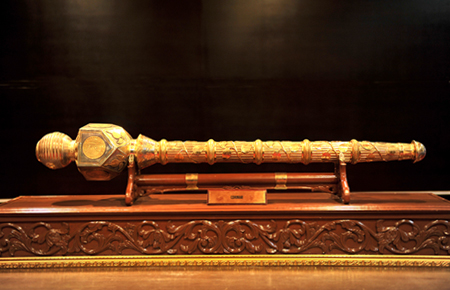
The Mace as a Symbol of University Eminence
The mace is a symbol of the university’s dignity and authority. Its head is shaped like a globe, featuring the national emblem of Malaysia positioned above the Jalur Gemilang (Malaysian flag). This signifies the university’s status as a higher education institution that upholds the nation’s mission and vision in its commitment to providing education to all citizens. Encircling the base of the globe is a ring inscribed in Jawi script with the words “Universiti Malaysia Sabah.”
The body of the mace resembles a lidded pedestal bowl, supported by a base. It bears the emblems of Malaysia’s states and the crest of Universiti Malaysia Sabah. Beneath the UMS emblem are two national floral symbols—the Hibiscus and the Rafflesia. The base and foot of the pedestal are adorned with traditional local motifs, including the bamboo shoot, geometric patterns, and rice motifs. The presence of nine rice stalks symbolizes UMS as the ninth public university in Malaysia.
The shaft of the mace is shaped like a staff, formed from several bound rods entwined with a climbing betel vine. This represents the unity of schools, centres, institutes, and units within the university. The binding rings symbolize statutes, acts, and regulations that serve as the guiding principles and ethical framework for governance, administration, and education. The golden betel vine encircling the shaft signifies the dynamism of the university’s academic programs.