

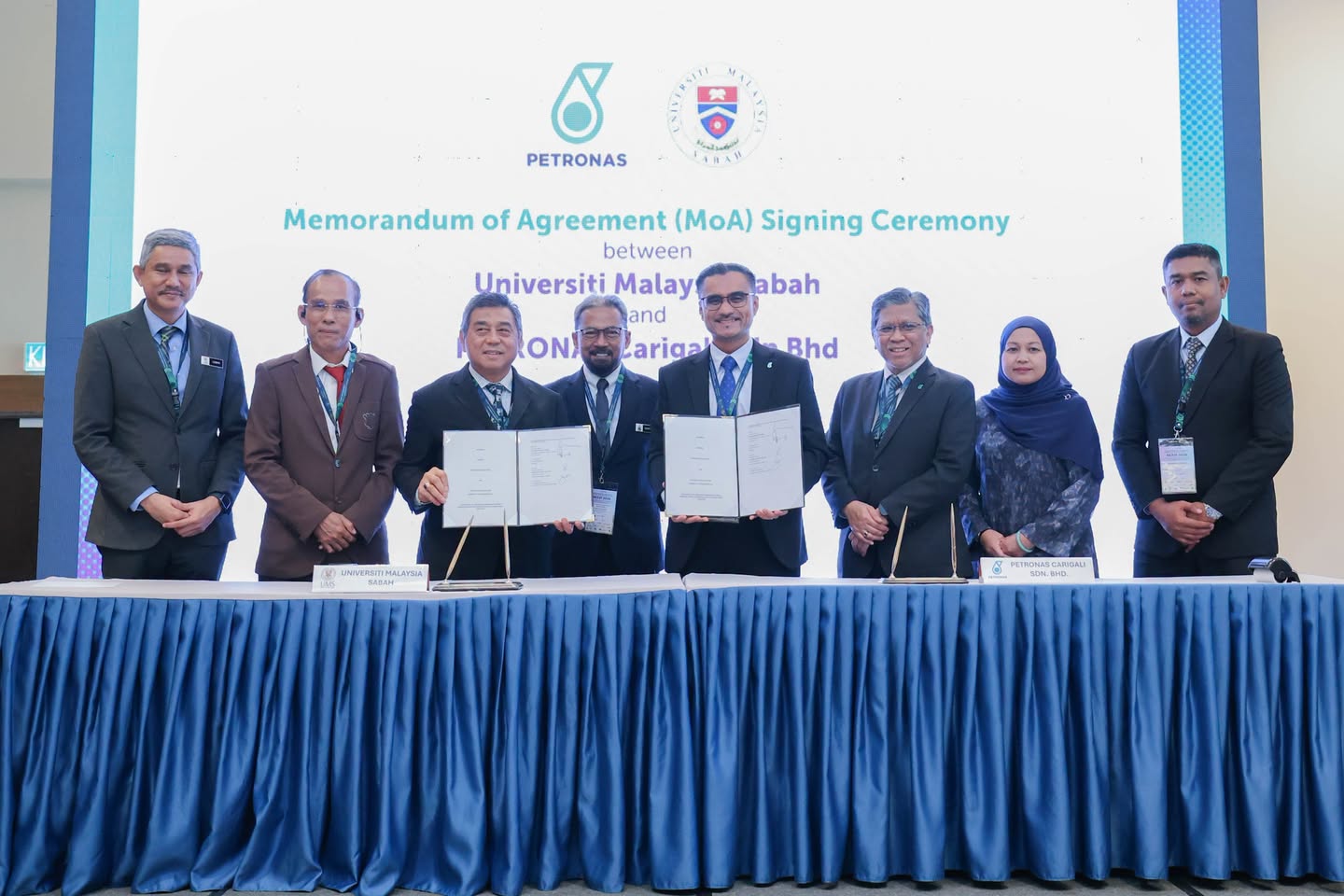
Universiti Malaysia Sabah (UMS) and PETRONAS, through PETRONAS Carigali Sdn Bhd (PCSB) Sabah Asset, have further strengthened their strategic industry-academia partnership through the signing of a Memorandum of Agreement (MoA) aimed at enhancing industry-based learning, developing future-ready engineering talent and promoting collaborative solutions to real industrial challenges.
The MoA was formalised in conjunction with the inaugural Borneo International Conference on Engineering, Science and Technology (BICEST 2026) held at the Sabah International Convention Centre (SICC), Kota Kinabalu.
The agreement was signed on behalf PETRONAS by Eruwan Gerry Norsen, Senior General Manager of PCSB Sabah Asset, and witnessed by Wan Zamani Wan Deraman, General Manager of PCSB Technical Services.
Representing UMS, the agreement was signed by Prof. Datuk Dr. Kasim Hj. Mansor, UMS Vice Chancellor, and witnessed by Luqman Ridha Anwar, UMS Registrar.
Also present at the event were Deputy State Secretary of Sabah (Special Duties), Chief Minister's Department, Datuk Mohd. Hanafiah Mohd. Kassim; PETRONAS Senior Vice President of Malaysia Petroleum Management, Datuk Ir (Dr) Bacho Pilong; and General Manager of PETRONAS Sabah and Labuan Regional Office, Datuk Siti Ayu Haniza Abdul Wahab.
The MoA builds upon the Memorandum of Understanding (MoU) between PETRONAS and UMS signed on 1 February 2025, which established the framework for strategic collaboration between the university and industry.
Under the collaboration, UMS engineering students undergo a three-month industrial internship placement with PCSB Sabah Asset, before undertaking industry-based projects as part of their Final Year Project.
Throughout the programme, students receive technical guidance and mentorship from PCSB Sabah Asset professionals and engineers, alongside academic supervision from UMS lecturers.
This structured approach enables students to gain direct exposure to industrial operations while applying engineering knowledge, analytical skills and problem-solving capabilities to challenges encountered in an actual operating environment.
The collaboration has already demonstrated encouraging results through its inaugural cohort in 2025.
A total of four industry-based projects were successfully completed by the 2025 cohort, exploring practical engineering solutions relevant to operations at the Sabah Oil & Gas Terminal.
Building on the success of the first cohort, six additional industry-based projects are currently being undertaken by the 2026 cohort, further expanding opportunities for students to contribute towards practical engineering solutions while developing industry-relevant competencies.
The initiative reflects UMS's commitment to strengthening the connection between academic learning and professional engineering practice while producing graduates who are better prepared to meet the evolving needs of industry.
In his BICEST 2026 opening address, the UMS Vice-Chancellor described the agreements formalised during the conference as concrete commitments towards research collaboration, human capital development and knowledge exchange, extending beyond the signing ceremony itself.
The partnership is also aligned with UMS's aspiration to strengthen its position as the “Brain of Borneo” through relevant research, capable graduates and meaningful engagement with industry and government on priorities affecting Sabah and the wider region.
For PCSB Sabah Asset, the collaboration provides an avenue to contribute directly towards the development of future engineering talent while facilitating the exchange of technical knowledge and experience between industry professionals, academics and students.
Beyond student development, the MoA provides a stronger platform for knowledge and expertise exchange, collaborative studies and projects, human capital development, and closer engagement between UMS and PCSB.
Through this partnership, UMS and PCSB Sabah Asset seek to demonstrate how structured collaboration between academia and industry can create mutual value by developing competent graduates, addressing real industrial challenges and strengthening the engineering talent stream in Sabah.