


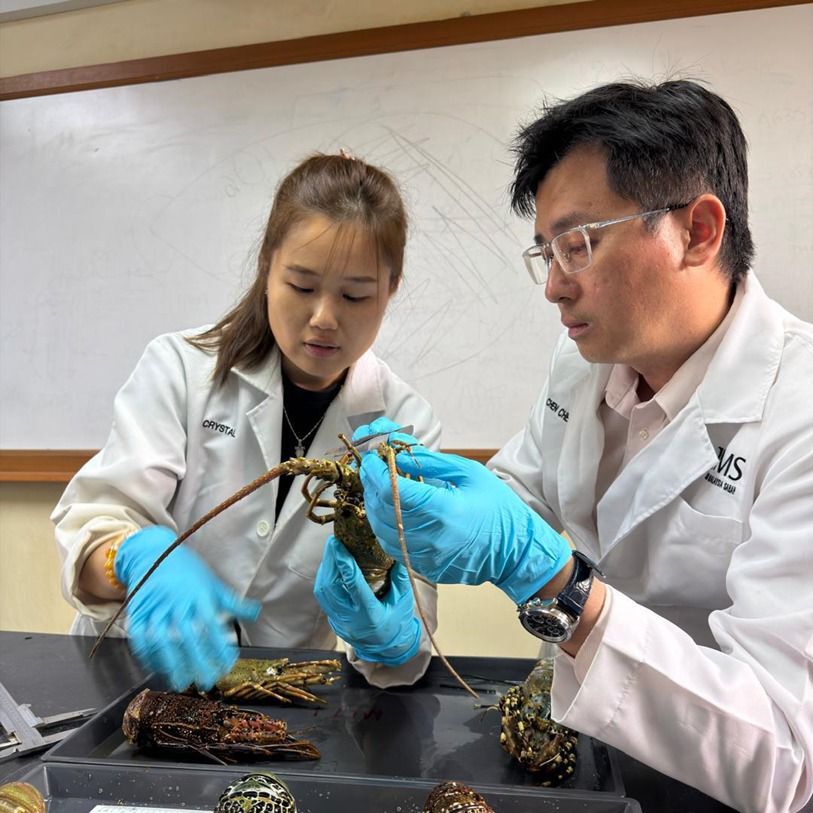
The Borneo Marine Institute (IMB) of Universiti Malaysia Sabah (UMS) has recorded three species of spiny lobster (Panulirus spp.) from the waters of Sabah for the first time, of which two are new records for Malaysia while one is a new record for Sabah.
This discovery strengthens Sabah’s status as a region of world class marine biodiversity.
The study, led by IMB researcher Associate Professor Dr. Chen Cheng Ann together with Master of Science student Ng Wei-Ling, identified three species of spiny lobster, namely Panulirus homarus homarus, P. polyphagus, and P. femoristriga from the coastal waters of Sabah.
Two of these species are new records for Malaysia (P. femoristriga and P. h. homarus), while another species (P. polyphagus) is a new record for Sabah.
Chen said the discovery is significant as it updates Malaysia’s marine biodiversity records and highlights the need to strengthen fisheries resource management in Sabah.
“Prior to this study, only three species of spiny lobster Panulirus ornatus, P. versicolor, and P. longipes had been known from Sabah waters since 2004.
“Our research has now doubled that number to six species, indicating that much of Sabah’s marine biodiversity remains unexplored.
“In related work, our team has also recorded Panulirus stimpsoni from Peninsular Malaysia, further expanding the national checklist of spiny lobsters,” he said.
Chen added that further research is needed to support the conservation and sustainable management of the newly recorded species.
He also noted that the study was conducted under challenging conditions during the COVID-19 pandemic due to movement restrictions and limited access to field sites and fishing communities.
“Despite these constraints, the study successfully doubled the known diversity of spiny lobsters in Sabah, including two species that are entirely new records for Malaysia,” he said.
UMS Vice Chancellor, Professor Datuk Dr. Kasim Hj. Mansor, commended the research team, describing the achievement as a significant milestone in marine science and a reflection of the nation’s research excellence.
“I would like to express my appreciation to Dr. Chen and Ng for their dedication and perseverance in carrying out this research,” he said.
Meanwhile, IMB Dean Associate Professor Dr. Faihanna Ching said the discovery also reflects the quality and strength of research conducted at the institute.
According to her, IMB, which was previously known as the Borneo Marine Research Institute (BMRI), was officially renamed the Borneo Marine Institute in January 2026 and is now expanding its research focus through the establishment of several new research centres, including in oceanography.
Meanwhile, the Director of the Sabah Biodiversity Centre (SaBC), Ken Kartina Khamis, said the discovery of the three new spiny lobster records highlights the importance of continuous research and documentation of Sabah’s biological resources.
“SaBC has granted the Access Licence for this study under permit reference number JKM/MBS.1000-2/2 JLD.13 (152) and (153), and we are pleased to see such meaningful outcomes from this research.
“SaBC encourages more researchers to conduct biodiversity studies in Sabah, as every new discovery strengthens efforts to develop more effective conservation strategies to protect the state’s natural heritage,” she said.
Meanwhile, according to the Director of the Sabah Fisheries Department, Datin Dr. Shuhadah Hj. Mustapha, the discovery is important in supporting fisheries resource management efforts in the state.
“Spiny lobsters are among the most commercially valuable crustacean groups, and the increase in known species diversity indicates that fisheries management protocols need to be updated.
“The Sabah Fisheries Department will take these findings into consideration in future management plans and looks forward to continuing collaboration with UMS,” she said.
Sabah Parks Director Datuk Dr. Maklarin Lakim said the findings provide additional scientific justification for strengthening conservation strategies in key marine protected areas such as Tun Mustapha Park and Tunku Abdul Rahman Park.
He also reaffirmed Sabah Parks’ commitment to continuing collaboration with UMS in efforts to conserve and protect the state’s marine biodiversity.
Previously, data on the diversity of spiny lobsters in Sabah had not been updated since 2004, and the increase in recorded species indicates that more marine biodiversity likely remains undocumented in the state’s coastal waters and islands.
The research team also suggested expanding biodiversity surveys, including the use of molecular tools such as environmental DNA (eDNA), as well as strengthening collaboration among government agencies, research institutions and local fishing communities to ensure Sabah’s marine resources are managed sustainably for future generations.
Published Articles
Findings from this study have been published in the following peer-reviewed journals:
Ng W-L, Chen CA, Mustafa S, Leaw CP, Teng ST, Zakaria SNFB, Tuzan AD & Chan T-Y (2022). A new record of the spiny lobster, Panulirus femoristriga (von Martens, 1872) from the coastal waters of Malaysia, with revision of global distribution. Biodiversity Data Journal 10: e77973.
Ng W-L & Chen C-A (2023). A New Record of Panulirus homarus homarus from Malaysia Waters with its Molecular Phylogeny. Borneo Journal of Resource Science and Technology 13(2): 175–185.
The access licence was obtained from the Sabah Biodiversity Council (SaBC) under reference number JKM/MBS.1000-2/2 JLD.13 (152) and (153).