


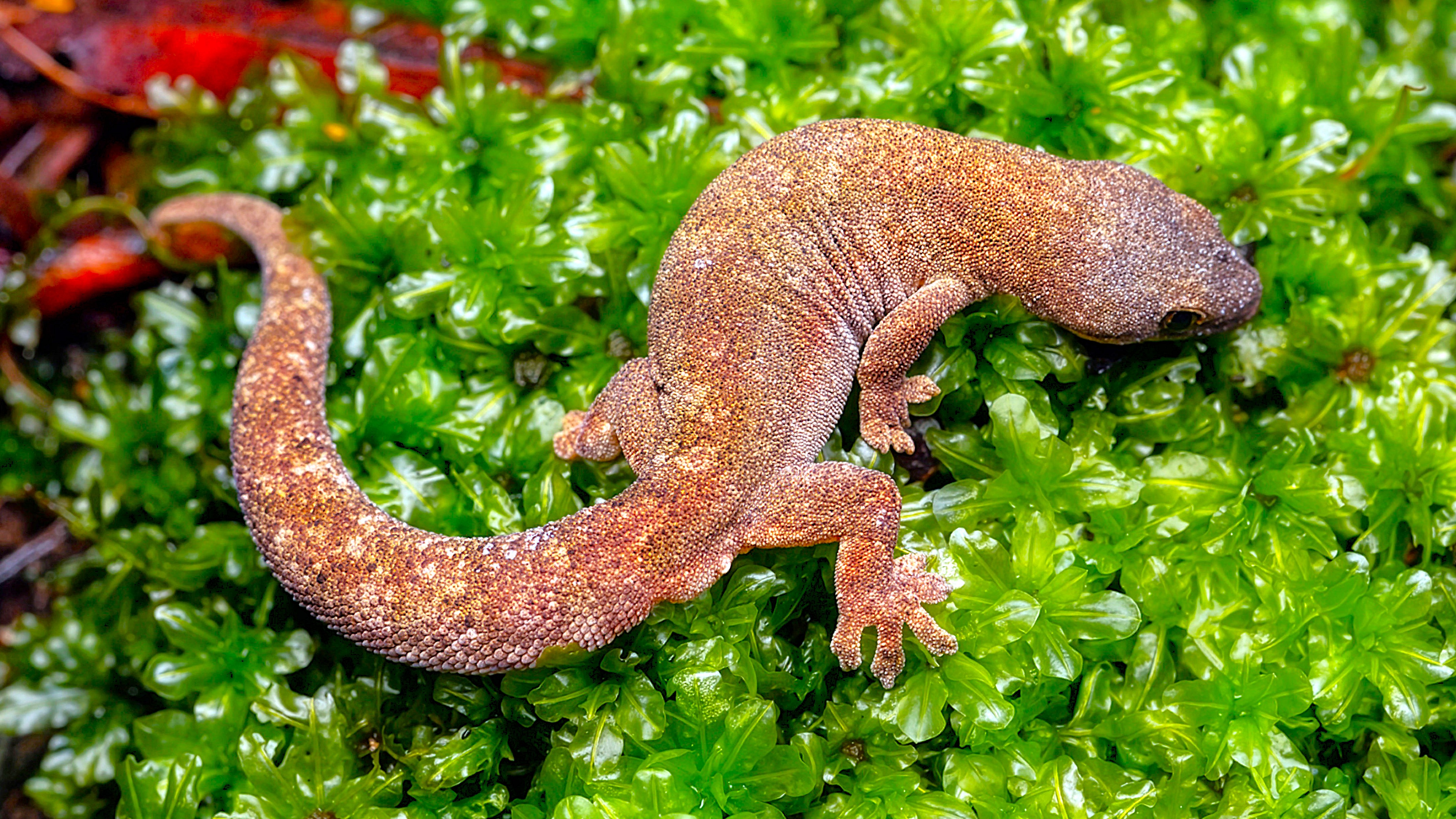
Newly named Lepidodactylus crockerensis reveals that even in one of Sabah's best-known mountain landscapes, nature is still keeping secrets.
High in the cool, mist-shrouded mountains of Sabah, a small gecko had been living almost unnoticed on the walls and eaves of buildings at Gunung Alab. To most people, it might have looked like an ordinary house gecko. To scientists from Universiti Malaysia Sabah (UMS), however, it told a very different story.
Detailed genetic and morphological investigations have confirmed that the animal is a species previously unknown to science. The newly discovered species was formally named Lepidodactylus crockerensis, the Crocker Range Mourning Gecko, after the Crocker Range where it was discovered.
The species was described by a team led by Assoc. Prof. Dr. Evan S.H. Quah, a herpetologist from the Institute for Tropical Biology and Conservation (ITBC), UMS, together with Aderina Dukit (Monash University), Fred Y.Y. Tuh (Sabah Parks) and L. Lee Grismer (La Sierra University). Their scientific paper was published on 22 September 2026 in the international taxonomic journal Zootaxa.
A tiny discovery with a big scientific story
The story began at Gunung Alab in Crocker Range Park. The holotype, the specimen upon which the new species is formally based was collected by Quah in the old Rhododendron Hut on 23 August 2025, at an elevation of 1,909 metres above sea level. Two additional male specimens form part of the type series.
The geckos were encountered at night in cool, misty conditions, with ambient temperatures between 14°C and 16°C. Individuals were found in the old Rhododendron Hut and were also observed on the walls and roof eaves of nearby buildings, where they are presumed to feed on insects attracted to lights.
But identifying them was not straightforward. The Gunung Alab gecko closely resembles Lepidodactylus ranauensis, another Bornean endemic associated with Mount Kinabalu. Science revealed what appearances alone could not.
Genetic analyses showed that the Gunung Alab population forms its own strongly supported evolutionary lineage. The new species differs genetically from L. ranauensis and shows statistically significant differences in morphology and scalation. The two occur in separate mountain ranges approximately 36 kilometres apart, with unsuitable lowland habitats between them.
Taken together, the genetic, morphological and geographical evidence was compelling: Sabah had another species new to science.
Only the third of its kind known from Borneo
Lepidodactylus crockerensis is only the third species of the genus Lepidodactylus recorded from Borneo. The discovery adds another important piece to scientists' understanding of how Borneo's isolated montane environments have shaped unique evolutionary lineages and highlights the Crocker Range as an important site for herpetological discovery and montane endemism.
The name crockerensis is a direct tribute to its home, the Crocker Range of Sabah.
The scientist behind the discovery
“This discovery reminds us that we still do not fully understand the herpetofauna of Borneo. Even in locations that are relatively well-studied, there are species that have lived alongside us for generations that have not yet been formally recognised by science. We now have a responsibility to better understand and conserve it and the vulnerable ecosystem it occupies.”
— Assoc. Prof. Dr. Evan S.H. Quah, Institute for Tropical Biology and Conservation, UMS
A discovery that places Sabah on the global scientific map
For the Vice-Chancellor of Universiti Malaysia Sabah, Prof. Datuk Dr. Kasim Hj Mansor, the discovery demonstrates the important role of a university located at the heart of one of the world's great biodiversity regions.
“This is more than the discovery of a new species. It is the discovery of new knowledge from Sabah that now becomes part of the world's scientific record.”
“When a species previously unknown to science is discovered and described by researchers from Universiti Malaysia Sabah, it demonstrates the strength of our scientists, the importance of our research institutions, and the extraordinary natural laboratory that Sabah offers to the world.”
“Borneo is globally recognised for its biodiversity, but we must never assume that we already know everything that exists here. Discoveries such as Lepidodactylus crockerensis tell us that there are still chapters of Borneo's natural history waiting to be written and UMS intends to be at the forefront of writing them.”
Prof. Datuk Dr. Kasim said discoveries of this nature also demonstrate why sustained investment in biodiversity science is essential.
“We need our field researchers. We need taxonomists. We need molecular laboratories. We need scientific collections. And most importantly, we need to develop the next generation of Malaysian scientists who will continue discovering, documenting and protecting our natural heritage.”
“The world comes to Borneo because of its biodiversity. Our ambition must be equally clear: the world should also look to Sabah for the science, expertise and knowledge needed to understand and conserve that biodiversity.”
“A small gecko found in the highlands of Sabah carries a much bigger message to the world, Borneo is still revealing its secrets, and UMS is here to help uncover them.”
“We cannot conserve what we do not know exists”
For Assoc. Prof. Dr. Fiffy Hanisdah Saikim, Director of ITBC, the discovery carries an equally important message about the urgency of documenting Sabah's biodiversity.
“Sabah is not only rich in biodiversity that we already know. It is rich in biodiversity that we have yet to discover.”
“Every time our scientists describe a new species, we are opening another page of Borneo's biological history. But we are also reminded of something much bigger: we cannot conserve what we do not know exists.”
“Somewhere in our forests, mountains, rivers and soils, there are almost certainly species that still have no scientific name. The question is not simply whether they are there. The challenge for science is whether we can discover, understand and protect them in time.”
She said the discovery reinforces the need for sustained investment in field exploration, taxonomy, molecular science, scientific collections and the development of young biodiversity scientists, particularly as many groups of organisms in Borneo remain incompletely documented.
Known from just one place, for now
Perhaps the most striking part of the discovery is how little is still known about this newly recognised animal. At present, L. crockerensis is scientifically known only from the vicinity of the Gunung Alab substation in Crocker Range Park. Researchers believe it may occur more widely in suitable upper-elevation habitats, but further surveys are needed to determine its true distribution, population size and ecological requirements.
Because it is presently known from only a single locality and little is known about its ecology, the research team recommends that the species be considered Data Deficient (DD) for conservation assessment purposes.
How many more species are living in Sabah's forests and mountains that science has yet to recognise?
And will they still be there when scientists finally find them?
The precious type material stays in Sabah
The specimens used to establish the new species have been deposited in the BORNEENSIS Zoological Collection at ITBC, UMS and duplicates will be shared with
their collaborator, Sabah Parks. This ensures that the physical scientific evidence documenting Lepidodactylus crockerensis is preserved in Sabah and remains available to support taxonomy, biodiversity research and future generations of scientists.
The research also reflects the value of collaboration, bringing together expertise from UMS, Monash University Malaysia, Sabah Parks, and La Sierra University.
Borneo is still revealing its secrets
For UMS and ITBC, the discovery carries a message far larger than the animal itself. Borneo is internationally recognised for its extraordinary biological diversity, but Lepidodactylus crockerensis demonstrates that the island's biodiversity story is far from complete.
Somewhere in a forest canopy, beneath the soil, inside a stream, on a mountain ridge or even on the wall of a hut on a misty Sabah night, the next species new to science may already be waiting.
And sometimes, a discovery measuring only a few centimetres is enough to remind the world just how much of Borneo remains unknown.
From Sabah, A New Name Enters The World's Record Of Life
Lepidodactylus crockerensis
The Crocker Range Mourning Gecko
Discovered in Sabah. Described by science. Preserved for the future.