
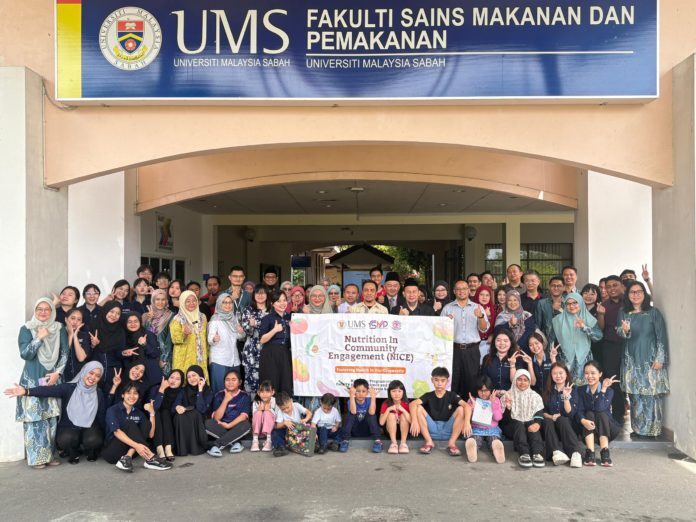
The Faculty of Food Science and Nutrition (FSMP) at Universiti Malaysia Sabah (UMS) formalized a strategic partnership with the Sabah State Islamic Religious Affairs Department (JHEAINS) during the closing ceremony of the Nutrition in Community Engagement (NiCE) 2024 program. Attended by key representatives from both institutions, the collaboration aims to deploy academic health expertise to students, teachers, and parents across State Religious Schools (Sekolah Agama Negeri). The initiative serves as a service-based learning framework designed to combat public health issues and tackle the double burden of malnutrition in children.
The strategic alliance was established through an exchange of Letters of Intent (LoI) between FSMP Dean Prof. Ts. Dr. Hasmadi Mamat and JHEAINS Deputy Director (Management) Mr. Ahmad Yusop following the conclusion of the NiCE 2024 program. Functioning as an immersive service-based learning model for Bachelor of Nutrition (Honours) undergraduates, the partnership integrates academic rigor with practical outreach. Central to this collaboration is the coordination of the "NiCE Living Lab," which applies a social-ecological research framework to examine lifestyle influences and deliver targeted health interventions. This structured approach directly supports FSMP and UMS's strategic priorities in driving community-centric health research and enhancing graduate readiness.
Highlighting the far-reaching impact of the initiative, UMS Nutrition Program Head Dr. Noor Atiqah Aizan Abdul Kadir noted that the program has actively engaged 173 undergraduates, produced 72 practicing nutritionists, and served approximately 285 community clients to prevent nutrition-related chronic diseases. The ceremony also celebrated milestone achievements, presenting certificates to 27 final-year Nutrition students for completing 280 hours of community service over their four-year degree, alongside honoring nine families from the 2021 NiCE cohort. "Through the coordination of the NiCE Living Lab, this collaboration enables us to identify and address pressing community health issues, particularly the alarming double burden of malnutrition among children," said Prof. Ts. Dr. Hasmadi Mamat, Dean of FSMP.
Looking forward, the partnership establishes a scalable model for university-led public health interventions that continuously enhance student competencies while delivering sustainable health solutions to local communities. This initiative directly supports United Nations Sustainable Development Goal 2 (Zero Hunger) and SDG 3 (Good Health and Well-Being) by establishing community living labs to combat childhood malnutrition and prevent chronic illness. Furthermore, it advances SDG 4 (Quality Education) and SDG 8 (Decent Work and Economic Growth) by embedding 280 hours of practical field experience to boost graduate employability, while exemplifying SDG 17 (Partnerships for the Goals) through multi-sectoral cooperation between academia and state government bodies.